“As a parent of a trans child, I sucked in a few sobs, but ultimately left the theater holding onto a line in one of the stories: to ‘never stop imagining a bright future for your child. . .’ [My wife and I] are grateful to be reminded that the bright future still exists — even as we fight for our kids’ lives in the too-often overwhelming darkness of this moment.” — Jon A. Stout, Co-Founder & Former Executive Director of Free Speech TV
Autobiographical Monologue Project
About Motus Theater’s What Love Requires Project
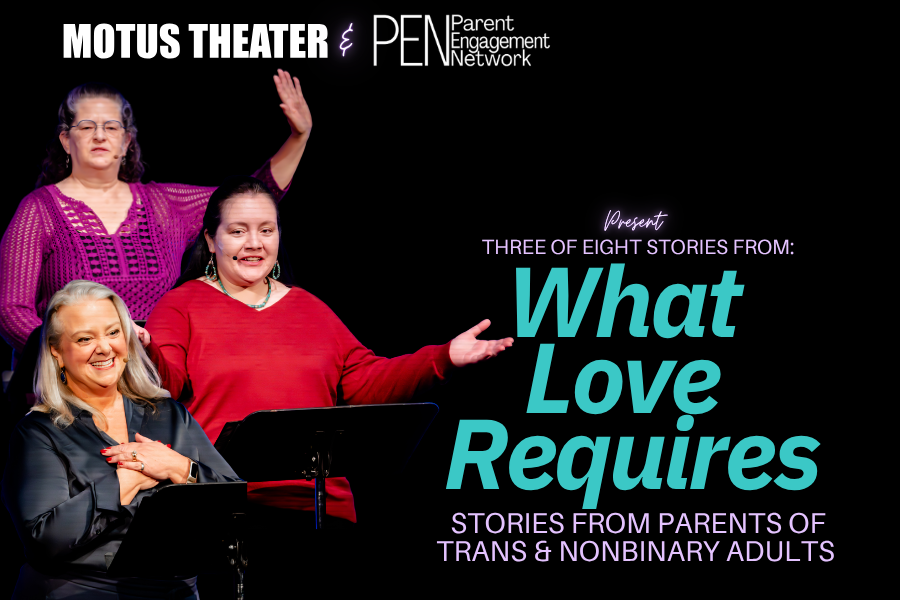
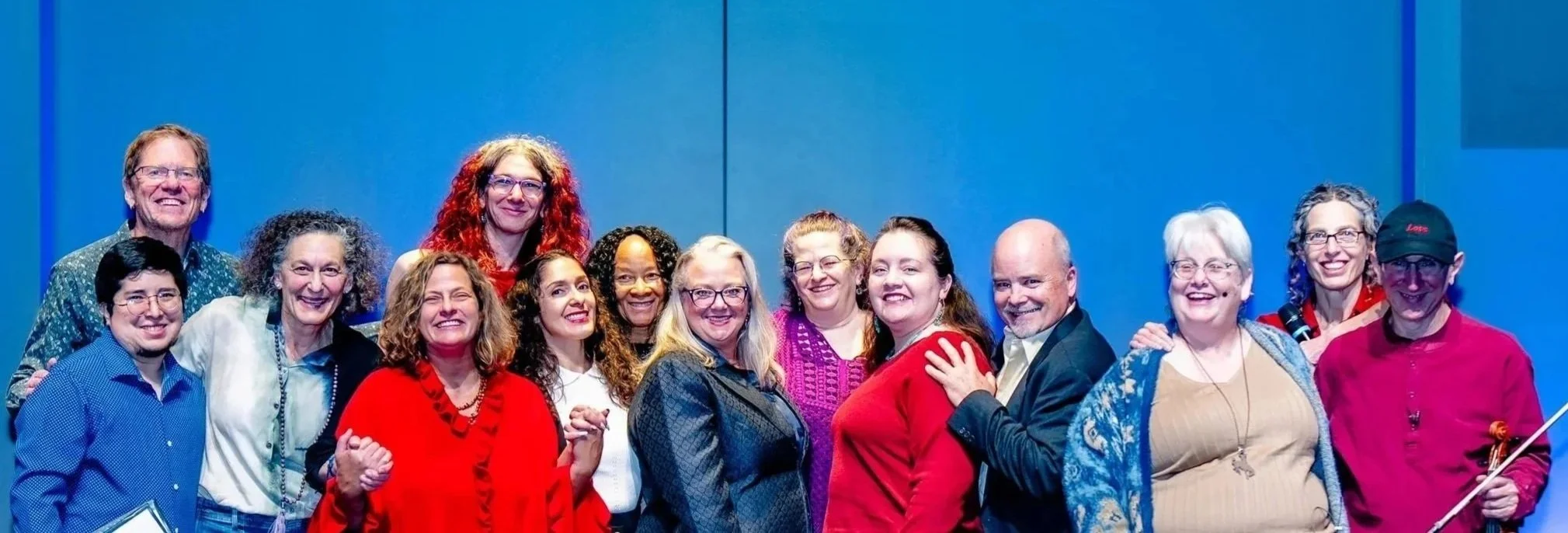
In Motus Theater’s What Love Requires (2025), parents of transgender and nonbinary adults share about the ways that they have transformed their own perceptions of gender and parenting to support their gender-diverse children to not only survive but thrive.
In many ways, the job of parents is to support our children to blossom into the unique gift they were meant to bring to the world. However, every parent’s idea of who our children are can be limited by family or societal expectations (“You were supposed to be a doctor like your parents, not a musician!”)
For parents of transgender and nonbinary children, supporting our children has particularly high stakes because of the threats our children currently face simply by living their own true gender, and experiencing the joy we all have when we can truly be ourselves.
What Love Requires monologues were created in collaboration with Motus Theater’s artistic director, Kirsten Wilson, as part of a 12-week transformative storytelling workshop focused on story development, public speaking, and support aimed at preparing monologists to speak on how supportive families drastically positively change outcomes for transgender and nonbinary people. The project builds upon Motus’ specialty of developing artfully crafted autobiographical monologues with leaders on the frontlines of violence in the U.S., putting them center stage as the protagonists in the American drama.
What Love Requires is the companion project to Motus Theater’s 2023 TRANSformative Stories monologues, in which transgender and nonbinary leaders present artfully crafted personal stories about their hopes, dreams, and experiences of negotiating oppression and liberation. The monologues disrupt dehumanizing perceptions and lift up the humanity of monologists.
Benjamin Lloyd - “Strong Hands, Soft Heart”
A father reflects on his nonbinary child’s journey into gender freedom, and how loving Noa helped him confront and shift inherited ideas of masculinity, privilege, and what it means to be a man with strong hands and a soft heart.
-
Benjamin Lloyd (he/him) is a Motus Theater What Love Requires monologist. He returned to Boulder in July 2025 after a thirty-year career as professional actor, theatre teacher, and nonprofit administrator in Philadelphia. While there he raised two remarkable kids and became an Eagles fan - Go Birds! Now at the beginning of his “Act 3” he is a graduate student in Clinical Counseling at Naropa University. He also teaches and performs improvisation of various kinds in and around Boulder.
“So I ask the other cisgender men here tonight: can you relate? Do you ever feel like you are performing the role of being a man except you can’t remember who the playwright is? Do you ever hear yourself saying something and then wonder, where did that bullshit come from? Is that really me? Have you ever suffered in secret, too ashamed to reach out to someone and say I am terrified of not measuring up, of not being enough, of not being a ‘real’ man?”
Julie - “Amongst the Stars”
A mother’s adoption journey becomes a path toward her own self-discovery and liberation as she stops trying to “fit into the little boxes” her family and society prescribed, and instead strives to be a “fitting mother” for her shining, brilliant, queer, nonbinary Asian-American child.
-
Julie (she/her) is a Motus Theater What Love Requires monologist. She holds a BA in Sociology and Anthropology, and two MA’s in Education. Over the course of her career she has worked in schools, outdoor leadership, and in a wide variety of roles in non profit organizations. Julie is an adoptive mom to an almost 20 year old. She is passionate about human rights advocacy, building community, creative endeavors of all kinds, and communing with the natural world.
“My child is one of those bright shining stars in the expanding cosmos and they live their values to the fullest – proud of being a young queer activist who chooses not to hide. And each day they inspire me to be a little bit more daring, a little more courageous – even expressing myself on stage today - which blasts me out of my own little box. But when you love your child you do your best to expand to meet their bigness.”
nan seymour - “Imagine a Bright Future”
A mother, terrified by her teen transgender daughter’s suicidality, learns to envision a ‘bright future’ she cannot yet imagine when she witnesses her daughter transform after gender affirming care, choose life, and marry the love of her life at a large church wedding.
-
nan seymour (she, they) is a Motus Theater What Love Requires monologist. She is the founder of River Writing, a liberatory shared writing practice held by community agreements. Relational repair between humans and the rest of the living world is the focus of her poetry. She lives on the land belonging to the Tohono O’odham People. She is grateful to reside alongside Saguaros, Gila Woodpeckers, and Vermilion Flycatchers in the Sonoran Desert, the most biodiverse desert on our planet.
“I wish that I could travel back in time to whisper sweetly and confidently in my own ear, “someday your kid will get married and people will rise to cheer.”
But there’s no way I would’ve believed that. And yet, here I am telling you now that my daughter married the love of her life and when she did, over a hundred jubilant people rose to their feet in exuberant applause!
In preparing for this event, I recalled many stories. So why did I choose this one? I chose it to remember that in the darkest, most terrifying time of my life a bright future awaited that defied my imagination.”
Leah Rodriguez - “My Baby Girl”
A mother’s fear for her child’s safety shaped her first reaction when her daughter came out as transgender. Luckily, this mother got a second chance to reconsider her perspective, move past the fear, and ground herself in the unconditional love that inspires her to fight for her daughter, and the rights of all transgender children to run, live, and blossom as their true selves.
-
Leah Rodriguez (she/her) is a Motus Theater What Love Requires monologist. She is a proud parent dedicated to utilizing her background as a community activist to support the transgender community. An accountant by profession, and intersectional activist through passion, she believes in building better community through action and communication.
“I am deeply blessed by the ways you have expanded my world and understanding of myself: It was my teenage daughter that reminded me of things I'd forgotten, freed my own self-expression, and gave me more confidence. Figuring out how to support you, reminded me that women don't have to look, act, talk, or relate to others in a certain way to be valid as women. I learned through you how to love my curly hair, and that I don't need to chase Eurocentric beauty standards. I don’t think anything could be better than being your mom, and the ways in which you growing into yourself, also liberated me.”
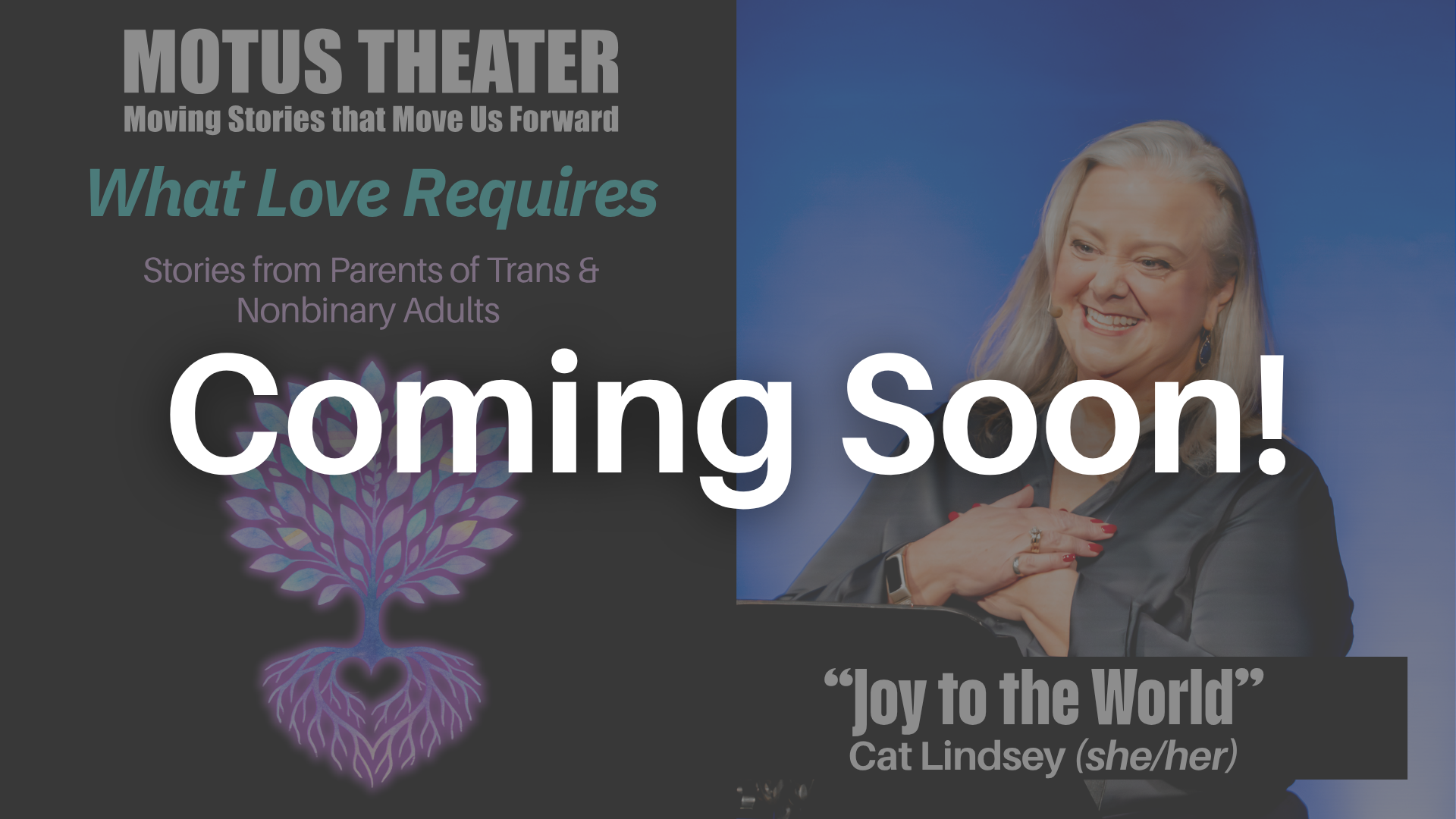
Cat Lindsey - “Joy to the World”
A mother celebrates her transgender daughter’s innate joy, musical brilliance, and fearless self-expression, and then grieves the way that expressive joy diminished in high school because of dysphoria. This mother shares her regret in preventing her daughter from receiving hormone therapy in high school, after she has a powerful shift in perception from witnessing her daughter's joy return after high school when she finally received gender affirming care.
“Having my daughter fully in her joy again made me realize just how much she had suffered. I wanted to turn back time and bulldoze my way through every roadblock that got in the way of those hormones, every roadblock that I put in her way, and give her back those four years she lost to her dysphoria.
But I can’t turn back time. I can only share what I learned the hard way with other parents whose trans child is ready to take the next step, whatever that is. And I can only celebrate that my daughter once again demands attention offstage as well as on. She does not want to be invisible.”
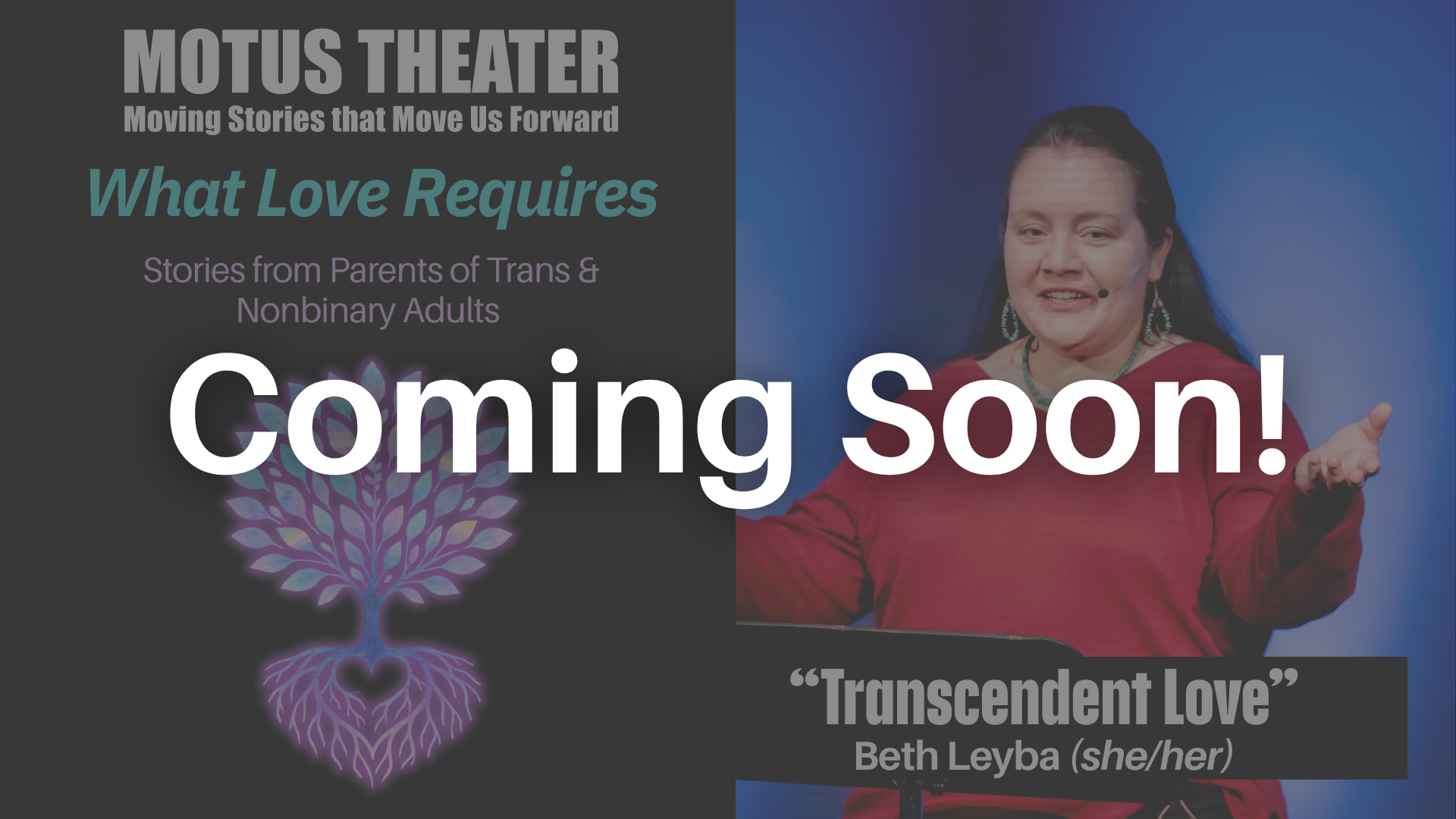
Beth Leyba - “Transcendent Love”
A mother reflects on the way her transgender child expanded her perceptions of gender, helped her reclaim her faith, and deepened her understanding that love requires transcendence or, in Beth’s words, “the ability to see and experience a humanity both beyond and deeper than the body.”
-
Beth Leyba (she/her) is a Motus Theater What Love Requires monologist. She is a Mestiza Chicana writer, storyteller, death worker, and accredited Enneagram Consultant & Coach. Her work is rooted in the reclamation of ancestral wisdom and uplifting her communities. She is a member of the LGBTQ+ community and the proud parent/stepparent/grandparent of several queer kids. Beth's community activism and volunteer work is centered around ending gender-based violence and assisting immigrant communities.
My child gently asked questions such as: ‘When did you know that you were a boy or a girl, and what that meant? Have you always felt happy and safe in that identity? Have you ever wished for others to see you as more than just that identity? Have you felt constrained by it? Disappointed with the rules it has imposed on your existence? The paths it has opened and closed? The societal expectations that come along with it?’
I had never thought about most of these questions before, and this opportunity to reflect deeply with my child about what it has meant for me to be in my body, and to be a woman in a man’s world were so generous in helping me understand my own journey.
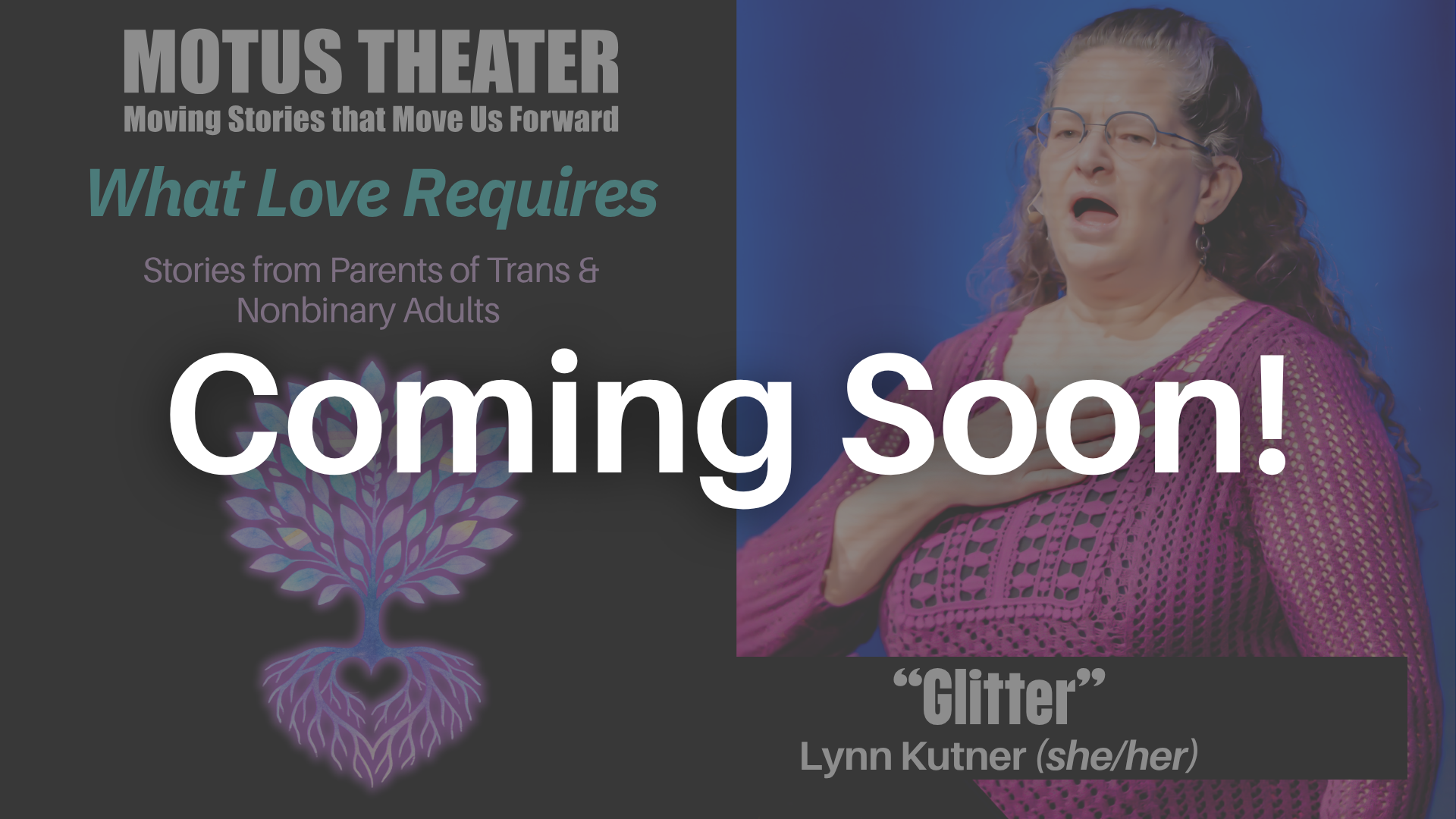
Lynn Kutner - “Glitter”
A mother reflects on her journey to grow alongside her nonbinary child as together they learn to celebrate what it means to be nonbinary. The audience is invited to witness this mother’s journey and reflect on how we learn to see our children and one another more fully.
-
Lynn Kutner (she/her) is a Motus Theater What Love Requires monologist. She is the proud parent of two amazing transgender non-binary children who are thriving in their beautiful unique identities. She is a passionate advocate for LGBTQ+ rights, serving on the PFLAG Denver Board of Directors as the Director of Outreach, as an inaugural member of Denver Public Schools’ LGBTQ+ Education Advisory Council, and as part of One Colorado’s Families for Trans Liberation Cohort. Lynn’s hope is creating a world in which ALL of our children can wake up feeling safe, loved, and like they have unlimited potential for their future.
“During one of those [pandemic] social distancing days, I proposed doing a gender affirming photoshoot. I remember Sam looking at me with that profound skepticism of a teenager who thinks their parent is from another planet. But the pictures from that afternoon capture my child’s journey from reluctant skepticism to eventually relaxing into themself until they are laughing for the camera with the delight of truly being themself.
With these photos, I finally had the accurate mirror I had been searching for that could reflect back to Sam the truth: They were not wrong, or broken. They were vibrant, radiant, alive. Sam, getting a glimpse of how beautiful Sam is.”
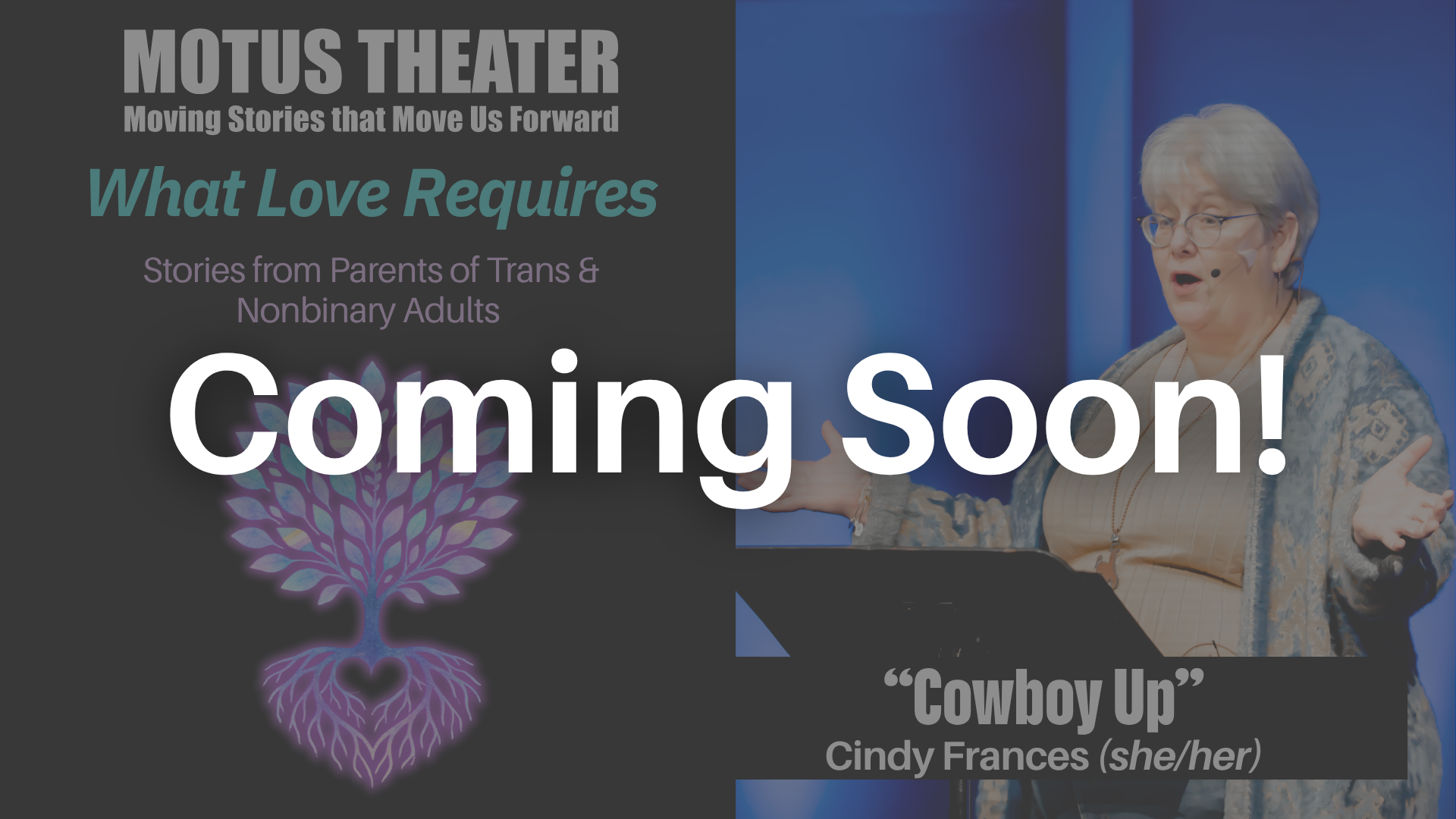
Cindy Frances - “Cowboy Up”
A mother draws on the rugged individualism and deep community care she learned from her Wyoming parents and grandparents as she reexamines what protection, courage, and love mean through her relationship with her transgender daughter. Her story invites audiences to question assumptions about identity, family, and what it truly means to “cowboy up” for another human being.
-
Cindy Frances (she/her) is a Motus Theater What Love Requires monologist. She was born and raised in Wyoming and currently lives in Colorado. She fully supports and LOVES her adult transgender child by channeling the ideals of rugged individualism and freedom; ideals that she was taught growing up. Cindy actively volunteers in her community in the areas of youth leadership development; supporting people experiencing housing insecurity and homelessness; and advocates for LGBTQ+ rights. By sharing her story Cindy hopes to help others understand the importance of supporting transgender people. Cindy envisions a future where everyone will COWBOY UP for transgender rights!
“My daughter said she was afraid to tell me she was trans, because she had read online about parents disowning and deserting their children when they came out.
Even though I had a lot to learn, I knew I was never going to desert my child! – ‘That, my baby girl, was never going to happen!’ What choice did I have when my daughter came out? Did it reflect badly on me that my child is transgender? That is what some claim.
But what if the mere fact that she told me represents our bond as mother and child? What if she was giving me a gift? The gift of sharing her true self.”